Why AI Watermarks Survive Some Edits
Cropping, compression, re-saving, and screenshots do not affect every provenance signal the same way.
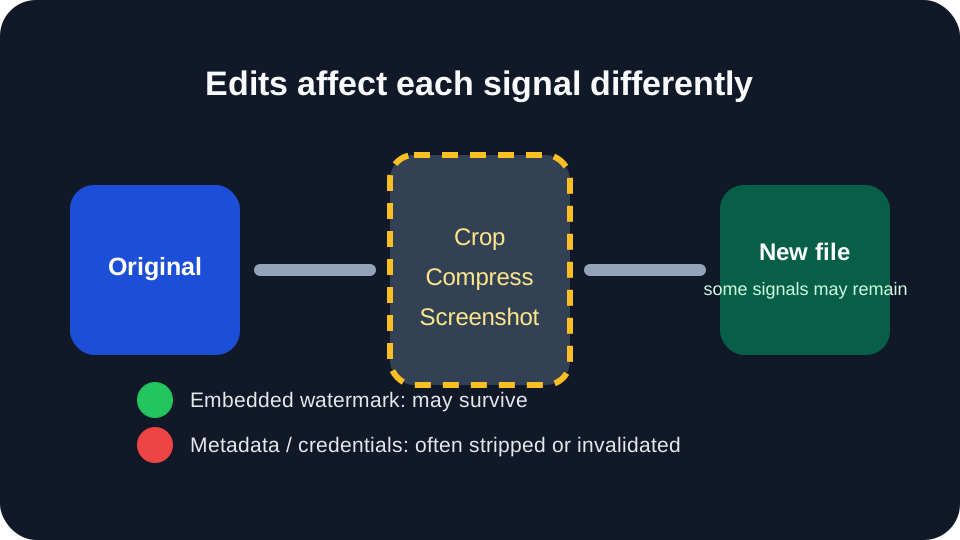
A common search is blunt: “Does crop remove watermark?” The better question is, “Which signal are we talking about?” A file can carry ordinary metadata, a signed C2PA manifest, a visible logo, an older Stable Diffusion-related invisible watermark, or a SynthID-style signal that needs Google's official tool. Those signals do not live in the same place, so they do not fail in the same way.
That difference is why removal claims are often misleading. One edit might strip metadata while leaving pixels mostly unchanged. Another might preserve a filename while breaking a signed credential. A screenshot might create a brand-new file that has almost none of the old container information but still resembles the original image. Provenance is a stack of clues, not one sticker on the corner.
Metadata is attached to the file container
Metadata is often the first thing people check because it is easy to inspect. It may include camera fields, software names, export timestamps, comments, thumbnails, color profiles, or generator-related tags. The EXIF metadata viewer can show many of those fields when they are still present.
Metadata is also fragile. A social network may remove it. A chat app may rewrite the file. A screenshot usually creates a new image with new metadata. An editing app may keep some fields, drop others, or add its own Software tag. That is why missing metadata is not a clean answer. It may mean the file never carried the field, or it may mean the field was lost somewhere along the way.
If your only clue is metadata, preserve the earliest version you have. Compare copies instead of trusting the final download. A file from the creator, a file from a platform, and a screenshot of the same media can tell different stories. The safest statement is about the exact copy tested.
C2PA credentials depend on a signed manifest
C2PA Content Credentials work differently. They are not just a casual text field. A file may carry a signed manifest that describes claims about creation, editing, or publishing. The signature is useful because it can help reveal whether the credential still verifies. Use the C2PA checker to see whether that kind of credential is present and valid.
The tradeoff is that edits and platform conversions can detach or invalidate the manifest. That does not mean the original credential was fake. It means the tested copy may no longer carry a verifiable record. A crop, export, or format conversion can create a new file whose relationship to the credential is no longer intact.
Think of C2PA as a signed receipt that can travel with a file when the workflow preserves it. If the receipt is still attached and verifies, that is meaningful. If it is missing, you do not know whether there was never a receipt or whether it was lost in transit.
Embedded watermarks are built for a different kind of survival
An embedded watermark is closer to a signal placed into the media itself. At a plain-language level, it is not just sitting in a metadata box waiting to be stripped. That is why some watermark systems are designed to survive common transformations such as moderate resizing, recompression, or partial crops. The exact behavior depends on the system, the file, and the amount of change.
Resilient does not mean indestructible. Heavy editing, aggressive compression, format changes, filters, screenshots, or repeated platform processing can damage a signal. It is also possible for different embedded systems to behave differently. The older Stable Diffusion-related watermark discussed on the Stable Diffusion watermark check page is not the same as SynthID. SynthID-specific checks belong with Google's official detector.
This is where “crop remove watermark” searches go wrong. A crop may remove a visible logo in a corner, break a layout, preserve enough embedded signal for one detector, or destroy the evidence a different detector needs. Without knowing the signal type and the tool reading it, the question is too broad.
Screenshots create new files, not clean histories
A screenshot feels like a reset button because it creates a new image. In one sense, it is: the screenshot has its own metadata, dimensions, compression, and creation context. It may no longer carry the original file's manifest or metadata. But the visual content is still derived from the original, and some embedded signals may or may not survive the capture process.
That is why a screenshot is usually weaker evidence than the source file. If you are investigating provenance, ask for the original or the earliest export. If you are publishing, keep the file that carries the strongest disclosure record. If you only have a screenshot, say that clearly. Do not pretend it is equivalent to the source.
The same caution applies to re-saving and compression. A smaller file may be easier to email, but it may be worse for checking provenance. If you must create a derivative, keep the original beside it and label the derivative as a changed copy.
Use resilience knowledge to preserve evidence, not erase it
This page is not removal advice. It is a way to understand why different checks produce different answers. If your goal is credibility, preserve originals, keep credentials intact where possible, and document the edits you make. If your goal is review, combine signal types and avoid sweeping labels.
For the full map of signal types, start with what can be detected in AI media. If you came here looking for a remover, read the honest answer about removing SynthID watermarks before uploading a file to a service you do not know.
The practical rule is simple: edits change evidence. Sometimes they remove it. Sometimes they leave part of it behind. Sometimes they create a new file whose silence says very little about the original.
Watermark resilience questions
Does cropping always remove an AI watermark?
No. Cropping can remove some visible or file-based clues, but embedded signals may behave differently depending on the system.
Why did metadata disappear after I uploaded a file?
Many platforms rewrite or strip metadata during upload, download, or compression, so the copy you receive may not match the source.
Can a valid C2PA credential break after editing?
Yes. Some edits or conversions can detach or invalidate the signed manifest even when the original file carried one.
Is a screenshot a reliable way to reset provenance?
No. It creates a new file, but it is weaker evidence and may still preserve or destroy different signals unpredictably.
When evidence matters, keep the source file and describe every derivative as a derivative.