SynthID vs C2PA Content Credentials
One signal is hidden inside media and read through Google’s route. The other is a signed provenance manifest that independent tools can verify.
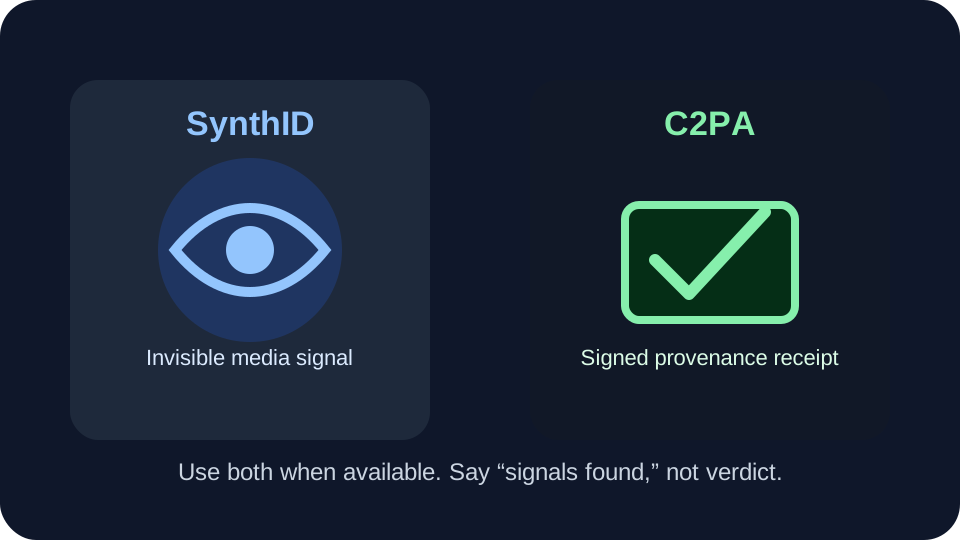
Someone asks whether a file has “the AI label,” and suddenly two very different systems get treated as interchangeable. SynthID and C2PA Content Credentials both belong in provenance conversations, but they do not work the same way. If you mix them up, you can overstate a weak result or miss a strong one.
The plain version is this: SynthID is a watermark associated with Google systems, embedded into the media signal and read through Google’s official detection route. C2PA is a signed manifest attached to a file, designed so independent tools can verify the credential when it remains present and valid. Both can help. Neither proves that a file is “not AI” when no signal appears.
The simplest comparison
Think of SynthID as a hidden mark and C2PA as a tamper-evident receipt. A hidden mark may survive some ordinary changes because it is part of the media itself. A receipt can carry richer context because it is structured data: who signed it, what actions were recorded, and whether the signature still validates. The tradeoff is that a receipt can be removed when files are copied, exported, screenshotted, or passed through tools that do not preserve it.
| Question | SynthID | C2PA Content Credentials |
|---|---|---|
| Where is the signal? | Inside the media signal, such as pixels or audio. | In a signed manifest associated with the file. |
| Who can read it? | Google’s official detection route for supported content. | Any compatible verifier can inspect and validate it. |
| What can it show? | That a supported Google watermark signal was found. | That signed provenance claims are present and valid. |
| What does absence prove? | Very little by itself. | Very little by itself. |
What SynthID is good at
SynthID is useful when the media plausibly came from a Google AI system and the question is specifically about Google’s watermark. Google has discussed SynthID across images, video, audio, and text in different product contexts. Because the signal is not just a visible label or ordinary metadata field, it is meant to be harder to notice and remove than a simple tag.
The limitation is access. A normal website cannot truthfully claim to decode SynthID unless it is using an official Google-supported mechanism. That is why our SynthID Detector guide points people to Google for the watermark itself. We can help with open signals around the file, but we do not pretend to read Google’s private detector output.
What C2PA is good at
C2PA Content Credentials are strongest when you need a readable chain of claims. A valid credential can say that a signer attached provenance information and that the manifest still validates. Depending on the file and issuer, it may include creation or editing actions. This is useful for publishers, tools, and teams that want provenance to be inspectable rather than hidden.
The public readability is the advantage. You can try it with our C2PA Content Credentials checker and see whether a file carries a manifest. The weakness is portability. If a platform strips the manifest, a later copy may not carry the credential even though an earlier version did. Absence is not proof of human authorship; it may only prove that this copy lacks the credential.
Where both systems break down
Both systems can be misread by people who want a single final verdict. A found signal means something specific. A missing signal means less than people hope. Recompression, screenshots, format conversion, copy-paste workflows, and platform processing can all change what remains checkable. The original file is usually more valuable than a reposted version.
There is another difference that matters in reviews: the audience for the evidence. A C2PA result can usually be shared as a credential report or repeated with another compatible verifier. A SynthID result is tied to the official detection experience. That does not make it weaker; it makes it less portable. If you are writing a policy, training editors, or designing an intake form, separate “internally checked with an official tool” from “independently verifiable by any reader with the file.” Those are not the same promise.
There is also a social failure mode. If an organization writes “no AI detected” when a tool merely found no readable credential, it has turned a narrow result into a broad claim. That wording can be wrong even when the tool worked perfectly. A better report says which system was checked and what happened: “C2PA manifest not present in this copy,” or “official SynthID check did not return a readable signal.”
How to choose the right check
If you need an official answer about Google watermarking, start with the Google route and read our warning about third-party checker claims before trusting a random upload form. If you need open, independently verifiable provenance, start with C2PA. If you are building software, the SynthID detector API status page explains why developers should implement C2PA and metadata checks rather than inventing an unofficial SynthID endpoint.
In real reviews, you may use both. A Google watermark result can answer one narrow question. A C2PA credential can answer another. Metadata can add context. The credible workflow is not “pick the magic detector.” It is “collect the signals that are actually readable, name them correctly, and stop before you turn missing evidence into a conclusion.”
Comparison questions people actually ask
Can C2PA verify a SynthID watermark?
No. C2PA verifies signed manifests. It does not decode Google’s SynthID watermark.
Can one file carry both kinds of signal?
In principle, a file may have more than one provenance signal. Each signal still needs to be checked with the right method.
Which one is better for public evidence?
C2PA is easier to show publicly because compatible tools can inspect the signed manifest. SynthID depends on Google’s official detection route.
Why not rely only on watermarks?
Watermarks can be useful, but access to detection may be limited and the result can be narrow. Open credentials provide a different kind of evidence.
The strongest provenance note names the signal, names the verifier, and refuses to turn silence into certainty.