AIGC vs C2PA vs SynthID: Three Kinds of AI Label
They get argued about as if they were the same thing. They are written by different systems, read by different tools, and prove different things.
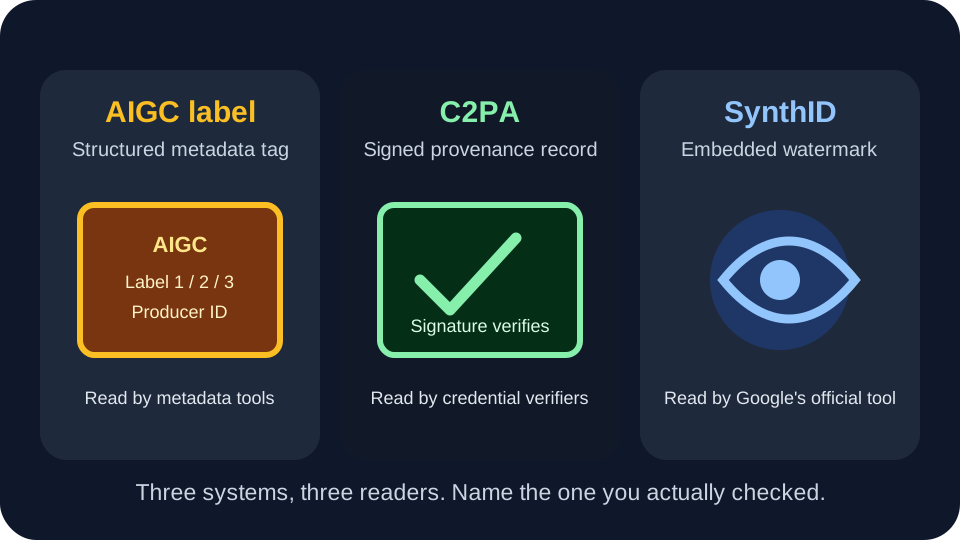
Picture the meeting. One person says the image has “the AI label.” Another says it passed a metadata tool. A third insists the real AI label is the watermark and that only a special service can read it. They are all talking about labels, and they are all talking about different systems. That is how a weak result gets overstated and a strong one gets ignored.
Three systems come up most often: AIGC metadata labels, C2PA Content Credentials, and Google’s SynthID. None of them is a universal AI detector. Each is a specific kind of mark with a specific reader. Once you separate them, the conversation gets much easier to keep honest.
The short comparison
| Question | AIGC label | C2PA | SynthID |
|---|---|---|---|
| What is it? | A structured metadata label. | A signed provenance record. | An embedded watermark. |
| Where does it live? | In the file’s metadata fields. | As a manifest attached to the file. | Inside the media signal itself. |
| Who can read it? | A metadata or label checker. | A compatible credential verifier. | Google’s official detection route. |
| What does a found mark show? | The file declares an AI-related status. | A signed record is present and may validate. | A supported Google watermark signal was found. |
| What does absence show? | This copy has no readable label. | This copy has no verifiable record. | This check found no readable signal. |
AIGC label: the tag written into the file
An AIGC label is a structured note stored in a file’s metadata. The clearest public example is China’s labeling system, which took effect on September 1, 2025 and pairs a visible mark with an embedded metadata record. That record can state whether the content is AI-generated, may be, or is suspected to be, and can carry a service provider name and traceability IDs.
The strength of an AIGC label is that it is structured and specific. When it is present, you can quote exact fields. The weakness is that it is still metadata. It can be edited, copied, or stripped by an export, a messaging app, or a screenshot. Use theChina AIGC label detector to see whether a file carries it, or read the plain-language guide to AIGC labels for how the field is organized.
The IPTC DigitalSourceType field belongs in the same family. It comes from a controlled vocabulary rather than a single regulation, and a value such as trainedAlgorithmicMedia means the file declares it was created with generative AI. TheDigital Source Type detector reads that field.
C2PA: the signed receipt
C2PA Content Credentials are not a single label but a signed manifest. Instead of one status word, the record can describe creation and editing actions and carry a signature that a verifier can check. That signature is the point: it lets a compatible tool say whether the manifest is still attached and still validates, not just whether some text is present.
That makes C2PA the most portable of the three when it is intact. Anyone with a compatible verifier can inspect it, which is a very different promise from “trust our website’s answer.” The tradeoff is fragility. A crop, export, format conversion, or platform rewrite can detach or invalidate the manifest. A missing credential does not mean the file was never credentialed; it means this copy no longer carries a verifiable record. TheContent Credentials checker shows what a file currently carries.
SynthID: the mark only Google can read
SynthID is Google’s watermarking family. Its signal is designed to live in the media rather than in a metadata field, which is why people treat it as a different category of evidence. It is also the one of the three that this site cannot read. As of this writing, an accurate SynthID answer comes from Google’s official tool, not from an independent website that claims to decode the mark.
That boundary is not a technicality. If a site says it “detects SynthID” without an official basis, you cannot tell a real result from a guess. Start with theSynthID detector guide for what the official route covers, and keep any result tied to the exact file you checked.
Which system answers which question
If your question is “what does this file declare about itself,” reach for the metadata label checks. They are fast, local, and precise about the fields they find. If your question is “is there a signed record I can verify independently,” use C2PA. If your question is specifically about a Google model’s watermark, that answer belongs to Google’s tool and nowhere else.
In real work you often use more than one. A C2PA credential can settle one question while a metadata label adds context, and an official SynthID check can answer a third. Ordinary fields like software names and dates fill in the background, which is why the EXIF metadata viewer is worth a look before you write anything down. None of these checks replaces the others, and none of them turns a missing mark into a verdict.
The mistake all three invite
The shared failure is treating a missing signal as a negative result. A quiet metadata field, an absent manifest, or an empty watermark check each tell you about one method applied to one copy. They do not establish that the content is human-made. Files lose their marks for ordinary reasons: someone took a screenshot, a platform re-encoded the upload, an editor re-exported the work, a tool never wrote the mark in the first place.
So keep every sentence matched to the evidence. “The metadata declares this was AI-generated.” “The manifest is attached and validates.” “Google’s official check reported a signal.” “No readable signal was found in this copy.” Those statements are useful precisely because they are narrow. For the full landscape of signals before you decide what to trust, start withwhat can be detected in AI media.
AIGC, C2PA, and SynthID questions
Is an AIGC label the same as a C2PA credential?
No. An AIGC label is a structured metadata field, while a C2PA credential is a signed manifest that can be checked for integrity. They are written by different systems.
Can one file carry all three signals?
In principle a file can carry more than one provenance signal, but each still needs the right tool to read it. Finding one does not mean the others are present or absent.
Which of the three is hardest to remove?
That is not a clean ranking. Embedded watermarks are designed to survive some edits, while metadata and manifests can be stripped by exports, screenshots, or platform processing.
Can I check SynthID with a metadata or C2PA tool?
No. Metadata checkers and credential verifiers read different parts of a file. SynthID should be checked with Google’s official tool, not inferred from another signal.
Does a missing signal prove the content is not AI?
No. Every absence is a statement about the method and the copy that was tested, not a conclusion about how the content was made.
Three systems, three readers. Say which one you actually checked.